Here is what to expect:
– Who it is for: homeowners, HOAs, businesses and property managers around Sarasota who have iguanas in the yard, along a seawall or near a pool deck.
– What is included: iguana trapping and removal, plus advice on the food and shelter that keep drawing them in.
– Where it applies: Sarasota and nearby communities in Sarasota and Manatee Counties. See the service areas below.
– How it differs from DIY: trapping takes careful trap placement and bait, and removal alone does not keep new iguanas away.
– First step: take a photo of the iguana and any burrows or droppings, note where and when you saw them, then call us.
Why Iguanas Invade Sarasota Properties
Iguanas are not native to Florida, and they are most common across the southern half of the state. Three kinds live here: the green iguana, the black spiny-tailed iguana and the Mexican spiny-tailed iguana. A female green iguana can lay 20 to 70 eggs in a clutch once a year, and she buries them in a shallow burrow, so a few iguanas can turn into many.
Iguanas are primarily herbivorous, so a yard full of ornamental plants, hibiscus, fruit and vegetable beds gives them plenty to eat. Thick shrubs and debris piles give them a place to hide. Waterfront and landscaped properties, common across Sarasota’s Gulf Coast neighborhoods, offer food, water and shelter in one spot, which is why the same yards see iguanas again and again.
Signs of Iguana Activity on Your Sarasota Property
Recurring activity is the clearest sign that iguanas have settled in. Look for:
– Burrows or holes in the yard, along embankments, under docks and beside seawalls
– Soil washing out or sinking around seawalls, pool decks and foundations
– Droppings on pool decks, patios and docks
– Chewed leaves, flowers and fruit on ornamental plants, hibiscus and garden vegetables
– The same iguanas showing up in the same area day after day
Do not handle droppings with bare hands. Take photos of the burrows, the droppings and the damage, and note the dates. It helps us see how long the iguanas have been there.
Professional Iguana Control and Trapping in Sarasota
Our approach is trapping and removal, paired with changes that make the property less attractive to iguanas.
1. Call 941-393-0304 and tell us where you have seen the iguanas and what damage you have found.
2. We look at where the iguanas feed, shelter and burrow.
3. We set traps where the iguanas travel and remove the iguanas we catch.
4. We suggest changes so new iguanas do not move in, such as trimming shrubs, clearing debris and using exclusion to protect seawalls and pool areas where it makes sense.
Trapping works best when the traps are placed and baited with care, which is why it is hard for a homeowner to do well. Removal alone is also rarely the whole answer. If the property still offers food and shelter, new iguanas tend to move back in within weeks.
Damage, Droppings and Health Risks
Iguana burrows can undermine seawalls, pool decks, foundations, embankments and docks, and the repairs can be expensive. Iguanas also strip ornamental plants and garden beds. Their droppings can carry Salmonella, which matters most on pool decks and patios where families spend time.
Green iguanas usually leave people alone if they are left alone. Black and Mexican spiny-tailed iguanas are more likely to scratch or bite if they feel trapped. Keep children and pets away from any iguana, and do not try to corner one.
Are Iguanas Protected in Florida? What the Rules Say
No. Iguanas are not native, and the Florida Fish and Wildlife Conservation Commission (FWC) encourages their humane removal. Because they are not protected, property owners can have them removed. Local rules still matter. Killing iguanas may not be legal everywhere, and there can be local limits on how it is done, so check with your city or county before you try anything yourself. A poor trap or a lethal method can also harm pets or other wildlife by mistake.
What Affects the Cost of Iguana Removal in Sarasota
The cost depends on how many iguanas are on the property, how large the property is, how much shoreline, seawall or landscaping they are using, how long they have been there and whether follow-up visits or property changes are needed. Tell us what you have seen and we will quote it. You can also get a quote online.
Iguana Control Service Areas Around Sarasota
We provide iguana control in Sarasota and nearby communities, including Siesta Key, Lakewood Ranch, Longboat Key, Bradenton, Palmetto, Osprey, Nokomis, Venice and North Port. We work with homeowners, HOAs, residential communities and commercial properties. Not sure whether you are in our area? Call 941-393-0304.
Iguanas are not the only wildlife we handle. We also provide raccoon removal and tegu removal for Sarasota properties.
Frequently Asked Questions
Should I hire a professional for iguana removal or try DIY methods?
We recommend hiring a professional. Trapping iguanas takes careful trap placement and the right bait, and it is harder than it looks. Killing iguanas may not be legal everywhere, and lethal methods can harm pets or other wildlife by mistake. A professional can also spot the burrows, food sources and shelter that keep drawing iguanas back. Call 941-393-0304 or request a quote online.
How can I permanently get rid of iguanas from my property?
Removal is only the first step, and no one can promise that iguanas will never return. Once the iguanas are trapped and removed, the property has to stop being attractive to new ones. Pick fruit and vegetables as soon as they ripen, keep pet food indoors, seal trash cans and trim dense shrubs and debris piles. We can point out what is drawing iguanas to your property.
Will iguanas come back after removal?
They can. Removal alone is a temporary fix. If the property still offers food, water and shelter, new iguanas tend to move in within weeks. Cutting off what attracts them, such as ripe fruit, favorite plants, hiding places and soft soil to burrow in, is what keeps a property unattractive over time. That is why we pair trapping with changes to the property.
Are your iguana removal methods humane?
Trapping is generally considered an effective and humane way to remove iguanas when it is done correctly. It also lets us target the iguanas causing the problem instead of putting pets or other wildlife at risk. When you call, tell us what you are dealing with and we will explain how we would handle it.
Can landscaping attract iguanas to my property?
Yes. Iguanas are primarily herbivorous, so ornamental plants, hibiscus, fruit and vegetable gardens are attractive food. Dense bushes, shrubs and debris piles give them places to hide, and soft soil along seawalls, embankments and docks gives them places to burrow. Trimming shrubs, clearing debris and picking fruit and vegetables as they ripen makes a yard less appealing.
What types of iguanas live in Florida?
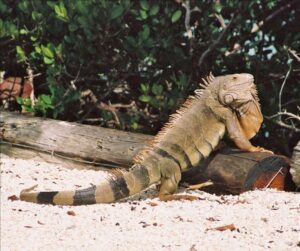
Three nonnative iguanas live in Florida: the green iguana, the black spiny-tailed iguana and the Mexican spiny-tailed iguana. Green iguanas are usually brown, gray, black or dark green, and males turn orange in mating season. Black and Mexican spiny-tailed iguanas have spiky tails and are more likely to scratch or bite if they feel trapped. If you are not sure what you have, send us a photo.
Can iguanas ever be completely removed from Florida?
Iguana populations continue to expand across southern Florida, so removing every iguana from the state is not something one property owner can do. What you can do is remove the iguanas from your own property and keep it from being attractive to new ones. That is where professional trapping and simple changes to food and shelter make the biggest difference.
Have iguanas on your property? Call 941-393-0304 or get a quote.