Do you have a tegu lizard problem? Here is what to expect:
– Who it is for: homeowners, businesses and property managers around Sarasota who have seen a tegu or its burrows.
– What is included: trapping and removal of the tegu, plus practical advice to keep tegus from coming back.
– Where it applies: Sarasota and nearby communities in Sarasota and Manatee Counties. See the service areas below.
– How it differs from DIY: tegus are large lizards, moving a live Prohibited species needs an FWC permit, and Florida does not allow releasing them. We handle all three.
– First step: take a photo from a distance, note where and when you saw it, then call us.
What Are Argentine Black and White Tegus?
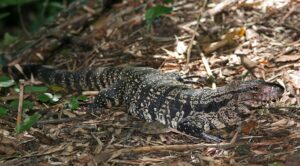
The Argentine black and white tegu (Salvator merianae) is a large reptile native to South America, where it lives in Brazil, Paraguay, eastern Uruguay and northern Argentina. Adults can reach nearly five feet long. They have a mottled black and white pattern that often forms bands across the back and tail. Hatchlings look similar but usually have bright green heads that fade after about a month.
Tegus eat almost anything. They are omnivores that consume fruit, eggs, insects and small animals, including reptiles and rodents. They will also eat pet food left outdoors.
Tegus are not native to Florida. The Florida Fish and Wildlife Conservation Commission (FWC) says reproducing tegu populations are established in Hillsborough, Miami-Dade and Charlotte Counties, with an emerging population in St. Lucie County. Tegus have also been reported in other Florida counties, but FWC says those are most likely isolated escaped or released pets, not breeding populations. EDDMapS, a public sighting database, lists 21 reports of Argentine black and white tegus in Sarasota County, the most recent in September 2024.
Signs of a Tegu on Your Property
These lizards are active during the day, so most people notice one first. Look for:
– A large lizard with black and white bands, or a smaller one with a green head
– Burrows or holes under brush, vegetation and debris
– Pet food disappearing from outdoor bowls
– Disturbed or empty nests on the ground
In winter, they retreat into burrows and go dormant, then start to come out again around February in south Florida. If you see one, do not approach it. Take a clear photo from a distance and note the location and date.
How Tegu Removal Works
Our approach is trapping and removal.
1. Call 941-393-0304 and tell us what you saw and where.
2. We look at where the tegu is feeding and sheltering, and set traps.
3. We remove the tegu from your property.
4. We suggest simple changes so tegus do not return: keep pet food inside, clear debris and cover outdoor openings.
Capture is a job for a professional, because trapping that involves live possession or transport of a tegu falls under FWC permit rules.
Why Tegus Threaten Florida Wildlife and Pets
Tegus are efficient egg predators. FWC says researchers have documented them eating American alligator eggs and disturbing American crocodile nests, and that they have eaten gopher tortoise hatchlings. They may also affect sea turtles and ground-nesting birds. Because tegus can establish across Florida, FWC is not looking to loosen the rules for keeping them.
A growing population also puts gardens and the food you leave outside for pets at risk, and FWC says tegus consume agriculturally valuable foods. Females lay an average of 35 eggs a year and may live up to 20 years, and adults have few predators, so a breeding population can build up over time.
Are Tegus Illegal in Florida? What the Rules Say
Tegus are on Florida’s Prohibited species list, effective April 29, 2021. Under state law, no one may keep, sell or breed them except for education, research, or eradication and control purposes. Pet owners who already had a tegu could get a free permit, and that window closed on July 28, 2021.
Never release a tegu or any other exotic animal. FWC says it is illegal to introduce nonnative species into the state, so a tegu caught in a backyard cannot simply be let go somewhere else.
What Affects the Cost of Tegu Removal
The cost depends on how many tegus are on the property, how large the property is, how long they have been there, where they are sheltering and whether follow-up visits are needed. Tell us what you have seen and we will quote it. You can also get a quote online.
Tegu Removal Service Areas Around Sarasota
We handle tegu removal in Sarasota and nearby communities, including Siesta Key, Lakewood Ranch, Longboat Key, Bradenton, Palmetto, Osprey, Nokomis, Venice and North Port. Not sure whether you are in our area? Call 941-393-0304.
Frequently Asked Questions
Who handles tegu removal in Sarasota, FL?
AAAC Wildlife Removal of Sarasota handles tegu removal for homes, businesses and properties in Sarasota and nearby communities. Tell us where you saw the lizard, when you saw it and what it was doing, and we will explain the next steps. If you can, send a photo taken from a distance, because it helps us confirm you are dealing with a tegu. Call 941-393-0304 or request a quote online.
How long does tegu removal take?
That depends on how many tegus are on the property, how active they are and how much cover they have nearby. One lizard that keeps returning to the same spot is a different job from several burrows under brush or debris. We will give you a realistic idea when you call.
Can you remove a tegu yourself?
We do not recommend it. FWC says permits are required for trapping that involves live possession or transport of Prohibited species, so catching one alive involves rules most homeowners are not set up to follow. Florida also does not allow releasing exotic animals such as tegus, so you cannot simply move the lizard somewhere else. Leave capture to a professional and keep children and pets away from the lizard.
Is tegu removal safe for my family and pets?
Keep children and pets away from the lizard and its burrows, and leave the capture to us. Do not try to corner it or pick it up. Keep pet food indoors and cover outdoor openings so nothing draws a tegu back to your yard. The CDC also says reptiles and amphibians are more likely than other pets to carry germs that make people sick.
Can you kill a tegu if you see one?
FWC says tegus are not protected in Florida except by anti-cruelty law and can be humanely killed on private property with landowner permission. That is what the rule says, not a how-to. The anti-cruelty law still applies, so any killing has to be humane, and a large, frightened lizard is hard to handle safely. We recommend calling a professional instead.
How do you report a tegu sighting?
FWC asks for three things: a clear photo, the location (GPS coordinates or a street address) and the date. Report it with the free IveGot1 app, at IveGot1.org, or by calling 1-888-Ive-Got1 (888-483-4681). Take the photo from a distance and do not approach the lizard. You can report the sighting and call us on the same day.
Are there tegus in Sarasota County?
FWC names Hillsborough, Miami-Dade, Charlotte and St. Lucie Counties for tegu populations and does not name Sarasota. EDDMapS, a public sighting database, lists 21 tegu reports in Sarasota County, the latest in September 2024, and 13 in neighboring Manatee County. Those are reports, not proof of a breeding population. If you see one, report it and call us.
What if I own a tegu I can no longer care for?
FWC’s Exotic Pet Amnesty Program has no penalty and no fee. It matches your pet with a qualified adopter, and FWC does not take possession of pets. Call the FWC hotline at 888-483-4681 and press 1, or email PetAmnesty@MyFWC.com. Please do not release the animal, because releasing exotic animals such as tegus is illegal in Florida.
In what states is it illegal to own a tegu?
This page covers Florida, where tegus are a Prohibited species and no one may keep, sell or breed them except for education, research, or eradication and control purposes. Other states have their own rules, so check with your state’s wildlife agency before you buy, move or keep one.
Got a tegu on your property? Call 941-393-0304 or get a quote.
Rules and sighting data on this page were checked on September 30, 2026. Florida rules can change, so confirm with FWC.